Εμφάνιση αναρτήσεων με ετικέτα 2018. Εμφάνιση όλων των αναρτήσεων
, , ,

Fashion Room Service by OZON Mag

The idea of 30 rooms full of local designers in one of the nicest hotels in Athens got me at first. 

The team of OZON mag chose brands like Debbie Tzima, Vassilis Moralis, Herais, Linda Cruz, Zero twenty_four, Fila, Urban Owl and more to fill in the boutiques rooms of Hilton and give us a point about today's trends of street style and some amazing all sequined night pieces.

For more check the designers:


Share:
Read More
, , , , ,

Make it rain | Valentino PreFall 2019 Collection


Valentino nevers fails to not dissapoint me. For another time the show at
Tokyo, Japan was amazing and truly breathtaking. The creative director Pierpaolo Piccioli
embraced the Japanese culture and created an extremely impressive
catwalk of  90 red gowns and designs.

Adut Akech and Kaia Gerber closed the runway and as if the show wasn't extraordinary
enough hundreds of red rose petals started falling from the ceiling.

Watch the full show here:


Share:
Read More
, , , ,

AW2018 Catwalk Hairstyles

1. Messy buns.  
   Chanel made the messy bun to look chic 
 during the runway with special hair accesories.


2. Slicked back ponytails.
Alexander Mcqueen and Bella Hadid followed the trend.


3. Blow dry.
Guido Palau stated " It's about rebellious girls, but not rebellious enough
to now blow her hair out"


4. Side parting.
Forget the middle parting of the 00s. It is now 80's again.


5. Bun with a twist.
Slicked back in the front but a beautiful surprise in the back.


6. Grunge aesthetics.
Max Mara and Marni had a "just woke up" vibe.


7. Jackie O bouffant bobs.
Jackie Kennedy's signature 60's hairlook was in Moschino show.


8. Sharp centre parting with smooth waves.
A hairstyle for the new chic it girls was shown at Alberta Ferreti show
with shiny roots and smooth easy wavy hair behind the ear.


9. 20s vibes.
Not only one era but many in AW2018 hairstyles.


10.  Huge curls.
Dolce&Gabbana's hairstylist Guido Palau used tiara and headpieces
 to give more glam to an ever glamour 
hair texture.


Nephele T.
c/f director


Share:
Read More
, ,

The double bag trend

For those who are multifarious one bag is not enough.
Famous designers displayed their idea for a double bag trend at their
spring summer 2019 collections with a compilation of different materials, like Loewe did,
or with the same bags in each side like Chanel. 

The trend consists of different sizes of bag for many causes, like mini card bags, bigger tote ones
for shopping or travelling. Other were more sophisticated for the office or the meeting .
The trend was followed by many designer like Fendy, Stella McCartney and more.
Balenciaga and Etienne Aigner started the trend back in 2014 for Fall/Winter collections
and now it is back.


Loewe


Givenchy

Gucci


Share:
Read More
, ,

AXDW X AVIOTI FASHION ED

Avioti Fashion Ed was another special addition of new designers in 24th AXDW.
Each design's energy was strong and you can feel it because of the variety diversity of the fabrics and styles. 

A big impression was made of a fabulous sparkly design that captured everyone's attention. It was a fresh creation that was sure giving you Victoria Secret vibes.


Another magnificant design was a dress-shirt one, with pleated bust and amazing symmetry between the true fabrics.


Every designer at the show had beautiful pieces to represent but it feels needless to represent each one individually. What matters is their work and their passion to create fashion.
These new designers are the future of the fashion market in Greece.


Share:
Read More
, , , ,

AXDW X LEFKON

Metallic headpiece by Lefkon


Irini Louisa Andrikopoulou created Lefkon in 2015.
Her idea was simple, to retread the minimalist aspect and movement that comes out of Greece.
Lefkon was the winner of "Emerging Designer of the Year" by Athens Exclusive Designers Week in 2018 and it soon established its character and its international unaided awareness by global magazines like Vogue Italia, Deux and Schon.

Lefkon came back in 24th AXDW to expound new ideas and designs, through a show that left a unique mark on the audience and of course in the greek market.

Combining Greek shapes and a vibrant pale blue colour, aery and balletic elements with the strong metallic feeling of the geometrical headpieces and the strictness yet youthfullness of grey textiles, the collection gave us the feeling that you can wear it anytime and anwhere, be stylish without the noisy today trends and still manage to not go unnoticed due to the strong art form of the designs.

Irene Louisa Andrikopoulou is an upcoming designer that is going to interest us more and more in the next years with new innovative designs that we can't wait to see.

More: https://lefkon.gr/index.php


Special thanks to Irene Louisa Andrikopoulou for the invitation to her show!

All photos taken by A Cluster Of Stars. gr


Share:
Read More
, , , , ,

Corporate Greenwashing.

Greenwashing  also called "green sheen",[1][2] is a form of spin in which green PR or green marketing is deceptively used to promote the perception that an organization's products, aims or policies are environmentally friendly.
 Although the term was first used by the enviromentalist Jay Westerveld to make hotels change their policy about towels, nowadays it is used by sneaky and huge worldwide businesses to attract conscius customers and to promote themselves as eco-friendly. The methods of greenwashing vary and its evolution is more sophisticated than ever. Going green is of course amazing but it can also be misleading.

There are many ways that a company can use to greenwash. Brands can make vague claims or omit important and relevant facts. They may do this inadvertently, just using information from their suppliers; in the recent case where several clothing companies claimed that they sold eco-friendly bamboo-clothing when they in fact sold rayon produced from bamboo - but processed in a way that uses harsh chemicals and can also release hazardous air pollutants.

A truly sustainable product, Lewis Perkins of Cradle to Cradle, a nonprofit organization believes, is a reusable item that has a positive impact on the environment and those who make it. That is an area where the clothing industry, which is based mostly on mass manufacturing in the developing world, has serious problems, mainly labor abuses and industrial practices that lead to pollution or accidents. These issues were highlighted in the starkest way last year when more than 1,100 garment workers were killed and about 2,500 injured after the collapse of a textile factory in Bangladesh. 


Greenwashing in the fashion industry:


Everyone that has walked into an H&M store has noticed the clothes recycling bin that gives you a 15% off. The company pretends to reuse these materials in order to make new pieces. H&M has been recognized as the world’s number-one user of organic cotton, which has a lighter environmental impact, and reduces the use of “probably” carcinogenic pesticides. But only 13.7% of the cotton H&M uses is organic. The production of clothing is still enormous and it is getting bigger and bigger by the year due to consuming needs. And a landfill overflowing with organic cotton is still an overflowing landfill.


Greenpeace in partnership with 76 retailers, is fighting greenwashing by creating the DETOX 2020 programme in 2011 to make companies choose the path of toxic free materials. NIKE was unfortunately the only brand that failed the programme, and we can also see that by the rage against the company during the last months, when people were burning NIKE products (still causing air pollution as a way to protest ) .  You can find the Greenpeace's list here

In conclusion sustainability and consumerism do not go hand in hand. It is admirable that all these brands are doing some work to change the way the product things, not only clothing, but cars, food, and even technology. 
There are very options out there that are "eco" or "sustainable" and it is now very confusing for the customers to validate what that means and to understand it fully..


References: Wikipedia, NFA, Aljazeera, The New York Times, Quarz, Greenpeace.


Share:
Read More
, , , , , , ,

The unpopular opinion of fashion as a Feminist tool


People often tend to believe that the fashion industry is a cruel world, especially for women. Many of them opinions, I have to admit, they are right. The industry projects unrealistic standards about female body and beauty, and a lot are those who choose to follow them in order to fit in and feel safe and as a result, suffer from eating disorders, extreme plastic surgeries, or mental issues. We have examples of that in celebrity life, many models suffered from anorexia or have been victims of sexual harassment, and from the people around us that absorb every trend. We are all super affected by these world, and we should all know how fashion leave its mark on us, in a positive way.


"The future is female."
Although men still run the industry, statistics show that women's labor, ideas and dollars pop up the industry. Women also dominate the student bodies at schools (like New York's fashion institute of technology), where 85% of students enrolled were female in 2016. A study called " The Glass Runway", by Glamour magazine in partnership with Counsil of Fashion Designer in America, showed that women weren't any less ambitious coming into the industry and that they were 17% more likely than men to aspire to be a top executive. Moreover, women are often the public faces of fashion and its big customers. But for much of the female focused industry which is self promoted as liberal and inclusive, there is a lot of work to be done to get businesses in line with the values they are publicly promoting.


"The suffragette of today."
 You can't fight revolution with silk gloves, but we can make an objection. There were times when a simple glove removed in a particular fashion could cause much a stir. And when women - and now men- figure it our, they didn't hesitate to use the fashion as an instrument of provocation. Personal style is now more fluid that ever. We can easily see men in tights and why not, in heels. People are free to wear whatever they want and how they want. Claire McCardell is often seen as the mother of american fashion , but while se ushered in the idea of sporty chic she also gave women a wardrobe that offered them a sense of freedom. The 80's power suit rejected the question "should a feminist adapt masculine dress or celebrate feminity?" and threw away the narrow definition of what is expected of them. The clothes they wore helped make their intentions known into the world.  After all what causes society to panic isn't different hemlines, but rather women defining for themselves what it means to be a woman. So the power of dress, was an important tool that influenced their standing in society, helping them towards less oppressive gender norms with every snap, zip, and fasten.


A scion of the Prada dynasty once said "It's important that we don't lose our feminity, that we find a way to do what men do, but in a woman's why", and I believe that this line includes it all.


Share:
Read More
, , , , , , ,

Architecture in fashion design

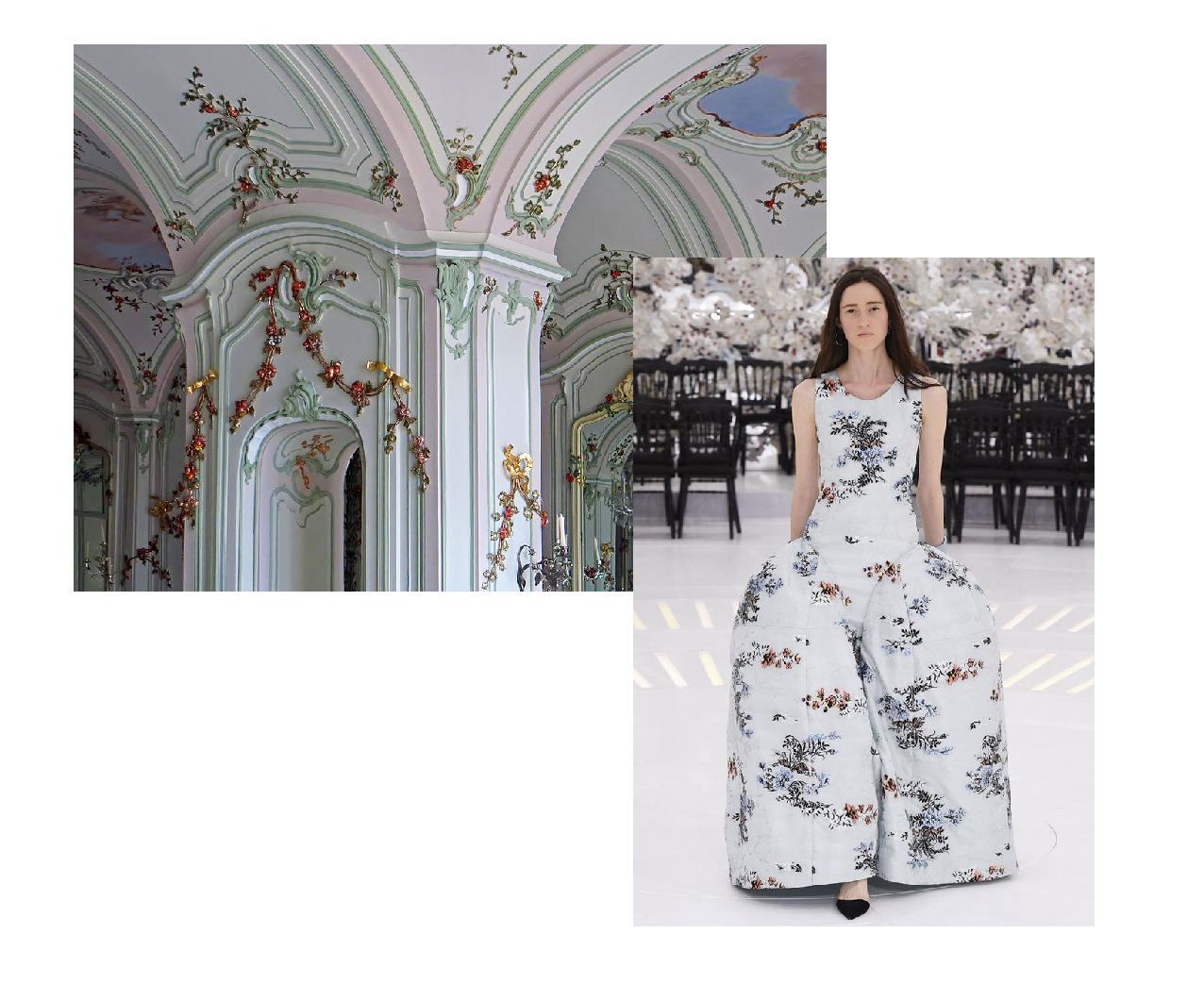
High fashion is able to find inspiration everywhere, in any form of art, one of those, architeture.
The connection between them two is visible mostly during a catwalk and not in everyday life due to the extravagant designs, fabrics and weight of the costumes.
Moreover many designers as late Pierre Balmain and Gianfranco Ferre come from an architecture backround. Balmain was the one that stated " dressmaking is the architecture of movement. " and I couldn't aggree more.

Pleating, folding and layering are some of the technics that are used in order to create the right angles, shapes and whole constructions. Omer Asim is also one of many designers that his architectural backround is a career milestone, most visible in his elegance and minimalist designs.


Each designer interprets their inspiration to meet their individual style.


                              1. Dolce & Gabbana S/S 2012 - Notre Dame de Reims, France,


                                 2. Givenchy F/W 2008 - The ceiling of a gothic building.                                                                     

                                3. Balenciaga Spring 2008 - Guggenheim museum, Spain.                                                                    

                                4. Akris Spring 2008 - Holocaust memorial in Berlin.                                                                          

5. Dior haute couture fall 2014 - Esterhazy palace Hungary.


6. Milly S/S 2016 - Zaha Hadid, Heydar Aliyev Center, Baku.
7.  KTZ Spring 2013 - Castle of Sammezzano Leccio in Reggelo , Italy. 


Share:
Read More
, , , , , , ,

In the footsteps of Mariano Fortuny.

Where: Palais Galliera, Museum of Fashion.
When: October 4th 2017 - January 7th 2018.

A museum in the heart of La Serenissima bears his name. He was a venetian by adoption, but spanish by birth, famous for his fine pleats… The man in question is Mariano Fortuny, and the Palais Galliera, City of Paris Fashion Museum, is devoting a retrospective to his work. With over a hundred pieces from the Galliera collection, Madrid’s fashion museum the Museo del Traje and the Museo Fortuny in Venice, the exhibition will reveal the full diversity of his inspiration. The famous ‘Delphos gown’, designed in 1909, is the quintessential illustration of his originality and inventiveness. It is made entirely from plain silk, and is so finely pleated that it can be rolled up into a ball and still maintain all its flowing lines when unrolled.
Mariano Fortuny y Madrazo (1871-1949) was the son of the Spanish painter Mariano Fortuny y Marsal (1838-1874) and, like his father, he started out as a painter. He moved to Venice in 1888 and his name has always been associated with that city. His highly eclectic tastes encompassed engraving, photography, furniture and lighting design, as well as stage design and stage lighting. In 1906, he turned his attentions to fabrics, with his “Knossos scarf” made of silk, printed with motifs inspired by Kamares pottery from the Minoan period. His dress designs liberated the female form. He reinterpreted the styles and motifs of Ancient Greece, the Middle-Ages and the Renaissance, and he created timeless, unwaisted pieces with soft, straight-hanging lines.
Mariano Fortuny features prominently in the works of Marcel Proust. At one point in Remembrance of Things Past, the painter Elstir tells Albertine: “But I hear that a venetian artist, called Fortuny, has recovered the secret of the craft, and that before many years have passed women will be able to walk abroad, and better still to sit at home in brocades as sumptuous as those that Venice adorned, for her patrician daughters, with patterns brought from the Orient.”
Fortuny would turn every fabric into a uniquely magnificent piece with subtle reflections of light. In the gowns worn by such legendary women as Countess Greffulhe and her daughter Élaine, Eleonora Duse, Ellen Terry, and Oona Chaplin, visitors can admire his carefully researched prints made from metallic powders on silk velvet, with their Byzantine, Japanese and Persian influences. The Mariano Fortuny exhibition is an invitation into the soft, shimmering world of a prolifically inventive designer who was a zealous advocate for liberating the female form, and a believer in the ultimate luxury: comfort.  A total immersion in timeless elegance.


The penchant for Hellenism:
Continuing a traditon born at the beggining of the 19th century, the first decade of the 20th century was obsessed with ancient Greece, a fascination expressed across all forms of creation, from architecture, to dance, to music and fashion.
In England, painting by Lord Frederic Leighton, Lawrence Alma tadema and John William Godward were all characterized by this sense of Hellenistic nostalgia, foreshadowing the Delphos gown. In 1902 the archaeologist Theodore Reinach, built the Villa Kerylos, in Beaulieusur- Mer, a replica of an ancient Villa on the Greek island of Delos. The sculptor Antoinne Bourdelle also took his inspiration from this period of history. Isadora and Reymond Duncan are other examples of well known figures spearheading the Hellenistic revival, a trend also embraced by the choreographer Mariquita and dancer Regina Badet.
This vogue found its full expression in the Russian ballets of Sergei Diaghilev whose innovative and vibrant productions set Paris alight from 1909 onwards. Narcissus, The Afternoon of a Faun and Daphnis and Chloe with sets and costumes designed by Leon Bankst were all programmed at Theatre de Chatelet. The penchant for Hellenism also extended into the private sphere: couturist Paul Poiret for example, organised the Festes de Bacchus (a lavish classically themed soiree) in June 1912. The same year Madeleine Vionet's winter collection featured an antique styled tunic.


In a tribute to Mariano Fortuny, Issey Miyake's "Pleats please" and the Valentino haute couture spring summer 2016 collection close this exhibition.
Robe flying saucer - Issey Miyake, 1994.

Valentino , 2016


You can also find "Peplos", another dress by Mariano Fortuny at the V. Papantoniou Peloponnesian Folklore Foundation ( PPF ) in Nauplio, Greece. 

All info were taken from Palais Galliera website.
Pictures by Nephelie Theofanopoulou.


Share:
Read More